The MARZ 2.5D
by Adrian Duncan
2008-05-01
Revised:
2010-05-15
2010-07-06
2010-07-28
 |
 |
 |
| Click on images to view larger picture. | ||
Here's a tale of dark deeds and derring-do from the cloak-and-dagger side of the model engine trade—the saga of the Russian-made "MARZ" 2.5D. Although long out of production, this interesting engine continues to be readily available worldwide today as a result of a rather "intriguing" (pun intended) past history, and it seems worth recording what is known about its origins, travels and technical attributes while we can still find someone who's both willing and able to talk!
This is a tale in which an unusually high element of skulduggery played a major part, and we are extremely grateful to Ed Carlson of Carlson Engine Imports in Phoenix, Arizona, for supplying a good deal of the following information regarding the murky details of this Iron Curtain engine's defection to the West in substantial numbers during the Iron Curtain era. We'll name no other names; even at this late stage, certain details are perhaps best left out! 
We are also greatly indebted to Ilya Leydman of Australia, who was instrumental in the world-wide marketing of the MARZ and other Russian engines in the early 1990's following the collapse of the Soviet Union and the consequent changes to the business climate in Russia. After reading our original article, Ilya was kind enough to fill in many additional details of this interesting period. Such first-hand information has a very high value in studies of this sort, and Ilya has our sincere thanks for his generous assistance.

Background
The origins of this refreshingly out-of-the-rut engine are rather shrouded in mystery, since the MARZ 2.5D made its initial appearance during the period in which the Russian-based Communist regime was still very much in control of affairs in the Soviet Union. During that period, reliable information regarding such matters as Russian model engine production was hard to come by, and we'll have to make do with what can be pieced together from a lot of rumours and a few definitely known facts. If anyone out there knows more, let's hear from you.During the period from the mid 1950's into the early 1960's when they were beginning to make their presence felt in International model competitions, the Soviets contented themselves for the most part with supplying would-be contestants with Russian-made copies of successful engine designs from elsewhere. These engines sufficed to allow aspiring competitors in the Soviet Union to gain the necessary experience to compete for places on national teams representing the USSR at the highest levels. They also served as aids in the technical and aeronautical training of young people in the school system throughout the Soviet Union.
As time went by, some of the more prominent Soviet competitors began to use special engines produced in very small numbers to very high standards by a few members of their own elite group. The rest had to make do either with the clones or with competition engines obtained somehow from elsewhere.
FAI team racing was one of the "glamour" classes which became a major preoccupation of Soviet modellers from the mid 1950's onwards. This class was dominated by high-performance 2.5 cc diesels, although the odd competitor did try a glow-plug engine from time to time, generally finding the fuel consumption issue to be a major barrier to success.
Initially, the majority of aspiring Soviet team racers had to make do with rather inferior Russian-made copies of successful 2.5 cc team race diesels from elsewhere, including a series of engines based on the Webra Mach 1 which were distributed under the MK-12 designation and a subsequent copy of the Super Tigre G20/15 diesel produced under the MD-2.5 Meteor designation. The aim was always to provide Soviet modellers with Russian-made engines with which to hone their skills for competition at the International level.

The first more-or-less original Russian FAI team race engine design to become generally available to Soviet modellers seems to have been the Ritm (aka "Rythm") 2.5 cc diesel designed by the well-known Russian team-race competitor Krasnorouski of Kiev in the Ukraine. The original production version of this engine first appeared in around 1962. It was to all intents and purposes a rear drum-valve version of the Oliver Tiger, with a bore and stroke combination plus a piston/cylinder set-up that very closely resembled those of the Oliver. However, the performance of the production version did not come up to then-current standards in stock configuration, although the engine could doubtless be tuned to give greatly improved performance. The use of drum valve induction allowed the tuner to take whatever liberties he chose with respect to the induction timing and porting without weakening any stressed component. This is in fact the greatest advantage of the drum valve set-up by comparison with the crankshaft rotary valve arrangement, and a revised form of it was to be employed on the later MARZ and KMD designs, doubtless for similar reasons.
The makers of the Rythm claimed an output of 0.32 BHP at 15,000 rpm for the original version, and this seems quite readily achievable based on my own tests of a properly set-up example currently in my own possession. However, a test by Ron Warring of a standard production unit which was published in the July 1963 issue of "Aeromodeller" yielded far more modest figures. Warring conceded that much of the performance claimed by the Russians appeared to be "there" in the design—it was manufacturing deficiencies that let the tested example down. The cylinder was later changed to a configuration based on the Cox twin-port system, but that did not help matters much and quality remained inconsistent. Clearly there was an ongoing need for an improved "consumer" design.

The Rythm remained in production in its later versions until at least 1975—I have a NIB example dating from that year. It was around that time or soon thereafter, according to some rather sketchy information gleaned by US engine importer Ed Carlson from business contacts behind the Iron Curtain, that the engineering department of the University of Moscow took a hand. The unsubstantiated story runs that they were asked to investigate the problem of coming up with an improved 2.5 cc team race diesel design suitable for mass production and that the MARZ 2.5D was the result. It's unreasonable to expect that we'll ever be able to prove or disprove this story, but it does make a great deal of sense. Although the influence of a number of previous Russian engines and others from elsewhere is quite clear in its design, the MARZ displays a refreshingly original combination of features which reflect a considerable amount of practical thinking in engineering terms. It would have made an excellent design assignment for a group of mechanical engineering students working under expert supervision in accordance with clear terms of reference.
Based on first-hand information supplied by lya Leydman, it appears that the majority of Russian model engines during this period were made under contract in restricted military production facilities as an off-peak activity to promote full utilization of equipment and staff. The MARZ was produced in a plant in Moscow which was primarily dedicated to the servicing of military helicopters. Indeed, the name "MARZ" was formed from the Russian-language initials of the company which made them; in English, the "Moscow Aero Service Factory".
Description
 The MARZ 2.5D is quite an interesting and original design in terms of the particular combination of technical features which it displays. All of these features had been used previously by others, but the MARZ did display some quite original thinking in terms of the combination of these ideas into an effective package.
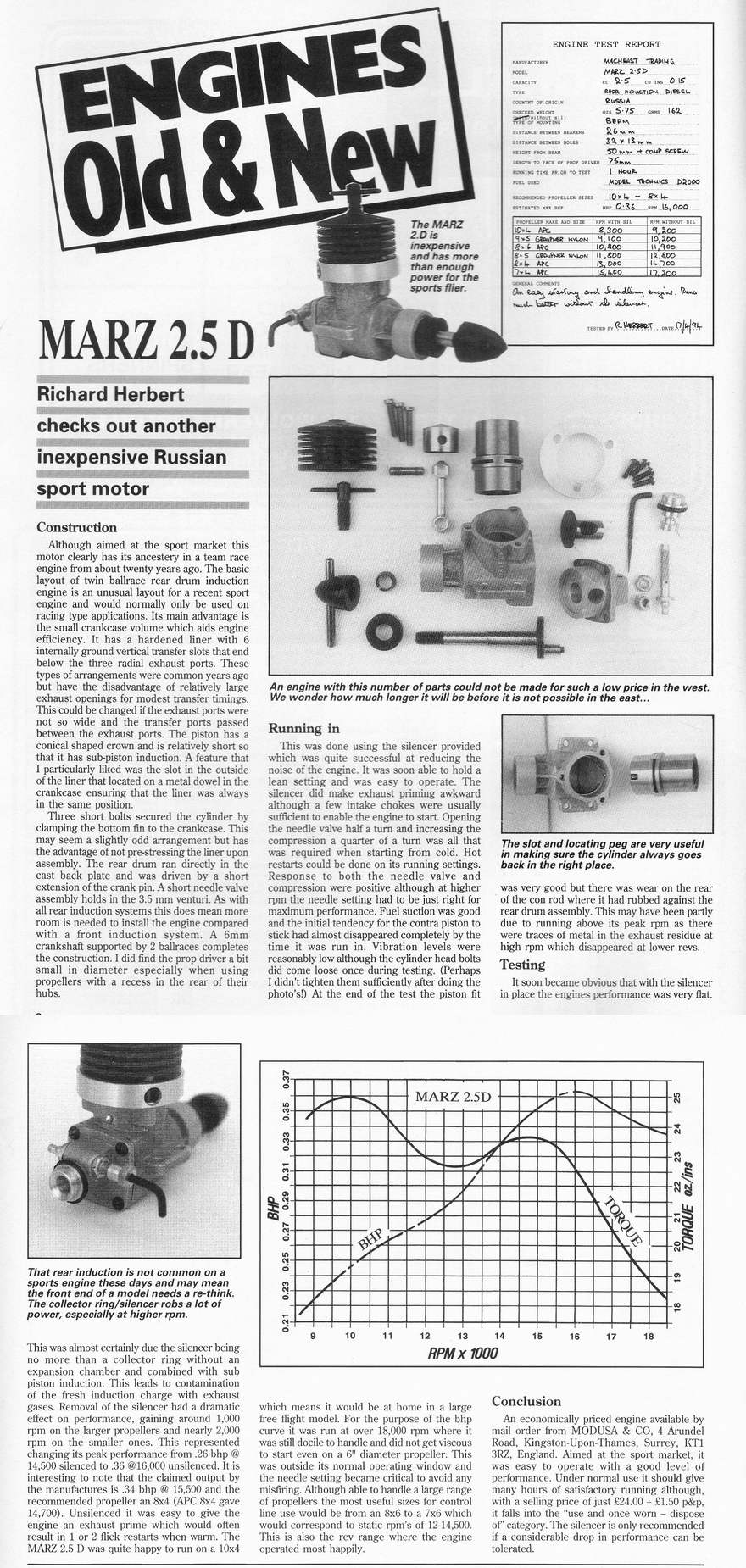
The MARZ was tested by Richard Herbert for "Aeromodeller" magazine, the test report being published in the July 1994 issue. This report includes a full description of the engine, and there is no need to repeat it in detail here. The most noteworthy design features of the MARZ are:
-
 The use of an unusually over-square bore-stroke relationship for a diesel, the bore being 15.5 mm and the stroke only 13.0 mm for a displacement of 2.48 cc. The concept of a significantly over-square diesel had of course been explored previously by manufacturers such as AMCO and Allen-Mercury in the UK. This set-up can be expected to promote improved high-speed running characteristics at some cost in terms of low and moderate speed torque. Less positively, it also promotes substantially higher internal stresses on the con-rod and crankweb.
-
 The use of the "reverse drum valve" system pioneered in the "classic" era by such engines as the Cox RR1 and the Frog 349. In this set-up, the interior of the drum is open to the atmosphere rather than to the crankcase (as it had been with the Rythm, for example), and the induction port feeds directly from the interior of the drum into the crankcase through a very short up-draft passage in the backplate unit. In effect, a crankshaft rotary valve in reverse. This arrangement provides both a very direct induction passage and a smaller-than-usual crankcase volume. In addition, the fact that the drum valve is un-stressed by the con-rod and does not have to transmit the engine's torque to the propeller allows the designer to take as large a "bite" as necessary for the induction port to maximize efficiency without worrying about mechanical strength. The design induction period of the MARZ is a healthy 178°, and this could be increased or the port enlarged by a tuner if desired with no loss of structural strength.
-
 The use of a Cox-influenced remote needle valve, with fuel being fed from an annular chamber around the venturi directly into the venturi throat via a ring of very small holes drilled around the circumference of the venturi. This creates an unencumbered venturi section and promotes excellent homogeneity of the incoming mixture, at some cost in terms of suction. Tuning for range and performance (critical for team racing) is a simple matter of changing venturis to a larger or smaller bore. The very efficient induction system which results from all of this is supplemented by a degree of sub-piston induction.
-
 The use of a modified form of the multiple internal flute transfer porting system pioneered in a diesel context by Elfin and AMCO and refined by Webra with their very powerful and successful Mach 1 diesel. This system had of course also been used in the Russian-made MK-12 series based on the Mach 1 and was also featured on the Hungarian Alag diesel engines. The MARZ uses 6 transfer flutes, as do the Webra, the Alag and the MK-12, but the flutes in the MARZ are grouped together in two groups of three flutes on each side of the liner rather than being uniformly distributed around the bore as with the others. This eliminates the front and rear transfer flutes, which would be largely encumbered by the crankweb and backplate anyway and could potentially be fouled by the gudgeon pin. It also prevents any interference between the transfer ports and the induction arrangements. The downside of this set-up is the fact that the transfer flutes have to terminate below the exhaust ports, thus restricting the available transfer period, which is only 98° on the MARZ. But the total transfer port area is very large, which doubtless does much to compensate for the short transfer period. And a fully-floating gudgeon pin can be used, making for greater simplicity of manufacture.
-
 The use of a metal dowel set into the crankcase at the rear which aligns with a slot milled in the exterior of the lower cylinder liner to ensure that the liner can only be installed one way. This is essential with this design since the liner is not radially symmetrical in terms of its porting arrangements and hence will only function correctly in one specific position.
- The retention of the cylinder liner by means of a cooling jacket which is secured to the crankcase by three screws at its base rather than in the more conventional manner by screws which pass through the entire length of the jacket. This ensures that the hold-down stresses are transferred to the liner at the exhaust port ring and that there are no distortional stresses set up in the jacket which might affect the liner above the port ring. This concept had been seen previously on engines such as the original AM 25 Mk I and the home-built Sugden Special as well as on the Russian MK-16 and MK-17 diesels of 1.5 cc displacement.


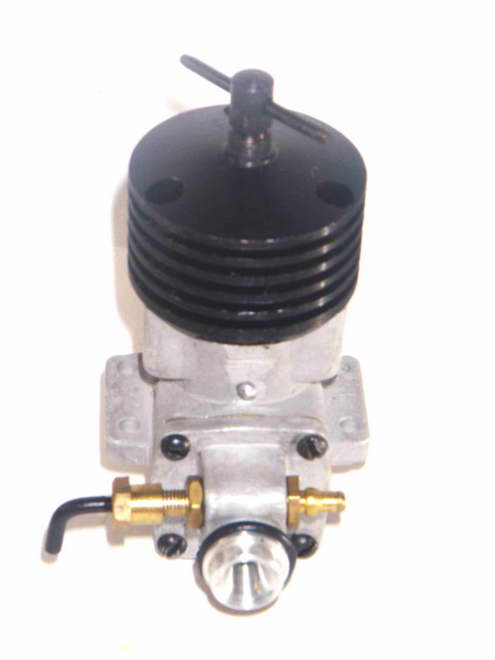
Otherwise, the MARZ is a more-or-less conventional twin ball-race diesel of "racing" pattern, with three conventional sawn exhaust ports completing the gas flow arrangements. Fits and finishes are generally good, although there are a few potential flaws (to be discussed below) arising from the fact that the engines were very much "mass-production" items. The bare weight of 5.5 ounces is by no means excessive for an engine of this specification and performance, and the unit has a nicely compact appearance with a very low frontal area.
Production and Distribution
On the basis of a number of common characteristics, it appears quite probable that the design of the earlier MK-17 1.5 cc diesel influenced the design of the MARZ. The crankcase configurations, crankshaft arrangements, cylinder hold-down arrangements and exhaust set-ups of the two engines are very similar indeed, although both the transfer and induction systems are quite different. The MARZ is certainly the more sophisticated design of the two, as we would expect if its design post-dated that of the MK-17.
Despite these similarities, Ilya Leydman confirms that the manufacturers of the MARZ had no connection with the makers of the MK-17. The latter engine, like the later KMD 2.5 cc team race diesel, was aimed specifically at the export market and was hence built to a higher standard of quality than other Soviet engines like the MARZ which were intended primarily for the domestic market.

The MARZ was launched upon the Soviet modelling world at some point in the final years of the 1970's and remained in production for some two decades or so. Evidently the intent was that it would replace the 1962 RITM (aka Rythm) as a "consumer-grade" team race diesel with which aspiring competitors could gain experience and with which Soviet youth could receive technical and aeronautical training. Like a good few other Russian engines, it appears to have been produced in very large quantities for distribution throughout the Soviet school and model club systems as well as being made available through official channels to aspiring competitors for use in learning their sport.
One of the underlying weaknesses of the Communist regime in the Soviet Union was the fact that rational economic principles were often set aside when the interests of the State were concerned. It was considered desirable to make State-sponsored products such as the MARZ readily and affordably available to the USSR school and model club systems and the "official" Soviet aeromodelling organizations for which they were intended, and consequently the "book" value of such products was often set at a figure which in many cases bore no relation whatsoever to the actual production cost. The State sponsorship under which the products were made presumably picked up the slack.
Ilya Leydman points out that there was a dark side to this state sponsorship, which might otherwise be taken to indicate a genuine interest in expanding the recreational and educational opportunities for Soviet youth. In fact, the school and club activities were closely monitored by DOSAAF, a para-military organization having a full title (in Russian" which essentially meant "Voluntary Association of Assistance to the Army, the Air Force and the Navy". This organization picked out the most promising participants from the school and club modelling programs and diverted them into training for military purposes.
The stated price of the MARZ in the USSR throughout its twenty-year production history was 11.50 Roubles. This was at a time when a Russian engineer might be paid 150 Roubles monthly. Hence the direct purchase of a MARZ engine represented a substantial investment.
It appears however, that a number of individuals in various Iron Curtain states managed by one means or another found a way to "divert" significant numbers of these engines (and presumably other products) into their own hands at a cost (to them) which was well below the actual cost of production and far short of the engines' intrinsic value.
This in turn led such individuals to consider ways and means of turning the engines obtained cheaply in this way into cold hard cash, a scarce commodity in the Communist bloc during the Iron Curtain era. Foreign currency was particularly desirable, leading to thoughts of exploring the possibility of somehow selling at least some of these engines on the Western market.
It was through this initiative on the part of the aforementioned Iron Curtain entrepreneurs that Ed Carlson, owner of Carlson Engine Imports of Phoenix, Arizona, first became involved (along with others) with selling the MARZ engines in North America and elsewhere. Even today, Ed is understandably reluctant to go into great detail, but suffice it to say that lines of communication were established with certain individuals in the Communist bloc who had examples of the MARZ and other Russian engines which they were able to offer at prices which were far below their intrinsic worth. As a businessman eager to build up his then-new model engine import business, Ed was only too happy to oblige.
Now, there was no legal impediment in their own countries to Ed and others purchasing these engines through appropriate channels from suppliers in the Soviet sphere of influence. The problem lay at the other end—since the MARZ engines (and other models which were also being offered at this time) were specifically intended for use in the Soviet school system and sports programs, their commercial export for personal gain was highly illegal and would have netted the Iron Curtain participants at least 6 months in jail for a first offence if they had been caught! So the engines which were diverted from the official supply system and sent to Ed and others could not be shipped in bulk as above-board export items. Instead, they were somehow sent out of the Communist bloc in tiny batches of two or three engines at most, minus any papers, boxes or anything else that would give them the appearance of being exported for commercial purposes. The papers and the flattened boxes would arrive separately.
This may look at first sight as if it should have been far more hassle than it was worth, but from a Soviet perspective the economics of the operation made a compelling case for participation despite the obvious risks. The suppliers could apparently get the engines for the equivalent of a few dollars—far below their true cost of manufacture. They were thus able to sell them to Ed and others like him at a typical cost of, say, US$15 each and make an instant 700% profit right off the top! And because at the time in question these were viewed in the West as rather exotic and hard-to-get engines from behind the forbidding and mysterious Iron Curtain, they attracted high levels of interest from collectors and engine aficionados worldwide. Accordingly, Ed and others were able at one time to sell examples of the MARZ for prices in the US$90 range. In other words, everyone made money.
Ed recalls sending monthly payments of up to US$500 at a time (by unspecified means) to his Communist bloc suppliers, and this at a time when a typical Soviet state take-home wage was perhaps some $14 monthly, according to Ed's contacts at the time. One can see why the State needed to keep the "book" selling prices of these engines down if they were to be put into wide circulation within the USSR.
Ed received his first examples of the MARZ in 1984, and the engines continued to arrive in the above clandestine manner for most of the balance of the 1980's. The engines received during this period had their original papers (sent separately). As was usual with Russian products at the time, these papers were dated, and the latest date that Ed recalls seeing was some time in 1987. It appears that manufacture continued up to the final days of the Communist regime in the USSR in 1990 and ceased shortly thereafter. By this time, of course, the MARZ had in any case been supplanted by more sophisticated production designs such as the KMD 2.5, a purpose-built team race diesel which carried over a number of features from the MARZ but adopted the far more efficient Schnuerle porting system. The KMD was of course aimed specifically at the export market, as noted earlier, and was thus built to very high standards.
However, this was very far from being the end of the MARZ saga. Being made specifically for use in the school and sporting systems of a geographically huge group of politically-integrated states, the engines were literally produced by the warehouse-full, and large numbers of unassigned engines remained in storage in Russia and possibly elsewhere when the old political system finally came to an end at the beginning of 1989.
The next move in the marketing game came from a company called Macheast Trading which was located in Sydney, Australia. This business had been founded in 1988 by Ilya Leydman for the purpose of marketing a range of model engine designs and accessories. In 1991, following the collapse of the Soviet Union and the consequent changes to the prevailing system, Ilya travelled to Russia to assess the possibility of adding to Macheast's range of products from Russian sources.
Ilya found the country short of almost everything except model engines, which they had in extremely large numbers for the reasons stated earlier. It was during this trip that he acquired the first batch of MARZ engines to be marketed by Macheast.
The sales response was sufficiently encouraging that Ilya decided to attempt to expand his marketing efforts in connection with Soviet products. In 1992 he returned to Russia and visited a number of production facilities, including the Moscow helicopter servicing facility at which the MARZ engines were made. It was only after the collapse of the Soviet system that foreigners like Ilya were allowed supervised access to these previously restricted plants.
Ilya found that the factory was well equipped with good quality CNC machinery, on which the majority of the machining required to make the MARZ engine was undertaken. Use was made of materials recovered during helicopter repairs—instance, the 50 mm steel rods supplied with MARZ engines for tightening the spinner nut were in fact discarded needle bearings from helicopter rotor assemblies!
The model engines were produced in a dedicated area consisting of two large rooms in which the special equipment required to make the engines was located. A key piece of equipment was the die-casting machine, which produced two crankcases and two rear drum valve housings from a single die as a single casting which was then parted off to create the four components.
Ilya was able to obtain production figures for the MARZ which indicated that some 500,000 examples of the engine were made during the two decades or so that it was in production. No wonder there are still so many new examples available today. Most of these were distributed through the State educational and sporting systems, although some were sold in Soviet toy shops.
Interestingly, Ilya found that the MARZ factory had made another model—a 2.5 cc ABC unit intended for control-line combat and called the Taiphoon. This was designed by the CSTKAM agency. It appeared in three successive variants having different crankcase designs, but only some 20,000 were produced—paltry figure by Russian standards. Very few of these seem to have left Russia.
At the time of Ilya's second visit in 1992, production of the MARZ had ceased. Ilya and his Russian partner acquire the remaining stocks as well as the die-casting machine and some of the CNC lathes. They established their own manufacturing facility in Moscow making Zeus engines, but made no more MARZ engines given the substantial number of completed engines that already existed. They shipped some 10,000 MARZ engines to Australia, both complete and as parts. The incomplete engines were assembled in Australia and the world-wide marketing effort was run from there.
Australian-based clubs and hobby shops quickly bought some 1,000 examples of the MARZ engines, but this didn't go far towards liquidating the 9,000 engines that Macheast still had on hand. Accordingly, the marketing effort soon went worldwide.
Ed Carlson and others like him were now able to obtain these engines quite legitimately and straightforwardly from the new Australian source, and the MARZ thus became readily and openly available worldwide, with none of the former cloak-and-dagger arrangements being necessary. Apart from Ed's ongoing imports to the USA, the engines were also imported into America by RLJ (MECOA) and Hobby Club, as well as into Britain by Modusa & Co of Kingston-on-Thames in Surrey (Electronic Development's old stomping grounds). So although actual manufacture had now ceased, the MARZ was in fact just entering its international sales hey-day, and examples found their way around the world in quite large numbers, being still frequently encountered today in Australia, Europe, North America and elsewhere. The fact that the engines were now readily available on demand naturally brought prices down, and the engines were (and still are) sold for the most part at very reasonable prices.
In 1994, Macheast had what amounted to a "fire sale" of these and other Russian engines from the Communist era, and Ed Carlson acquired substantial stocks of the MARZ engines. Ed informs me (April 2010) that NIB examples of the Marz MARZ remain in good supply from his company (Carlson Engine Imports) and will likely continue to do so for years to come. According to Ilya, RLJ also has a significant inventory of these engines.
Serial Numbers
I have been able to discern no readily accessible pattern in the range of serial numbers encountered. All of the MARZ engines that I've ever see do have such numbers stamped on the rear face of their backplates below the carburettor, but it's difficult to extrapolate any obvious rational basis for them other than a straight sequence. The engines are stamped with a simple four or five digit number with no intervening breaks or other symbols.Ilya Leydman tells us that both the engines and parts received from the MARZ factory were already stamped with their serial numbers, so this must have been done prior to the final assembly stage. In keeping with established practise for Soviet mass-produced goods, the numbers reflected both the plant of manufacture and the date of completion. The original Soviet instruction leaflets included very specific 12-month warranty information.
The one possibly significant factor that I've observed is the fact that so far, every MARZ serial number with which I'm acquainted (and that's quite a few) has started with the number "2". The seven MARZ engines currently in my own possession cover a range of serial numbers from 2111 (my present "flyer") up to 26121. I currently know of five other nearby examples owned by others, all of which also have the number "2" as the starting point of their serial numbers. I'm unable to say whether or not this is significant—could it be a model indicator which is then followed by a number for the individual engine? Or could it be a batch number, indicating that all of the existing "in circulation" MARZ engines in the West come from the same batch of at least 6121 examples? Possible, I suppose—the fairly large stash which was brought out of the former USSR to create the inventory established by Macheast might all have come from one batch given that they probably all came out of the same factory warehouse. But we'll probably never know; if anyone out there knows more, please get in touch.
Versions
In design terms, the MARZ does not appear to have evolved at all following its introduction. Presumably it was found to be quite satisfactory for the educational and training roles to which it was assigned, and that was the end of it—changes were not warranted.However, the engine is to be encountered in at least four different configurations:
-
The most common version, with no muffler and a black anodized cooling jacket, prop driver and spinner nut.
-
A version which is identical to the above but has a plain un-anodized cooling jacket, prop driver and spinner nut. These are far less common than the first type.
-
A version of either of the above types (mostly with black anodizing, but a few plain) which has been fitted with a simple ring collector around the exhaust belt to serve as a muffler. This was not produced in Russia but was an accessory produced in Australia by Macheast to enhance the engine's appeal as a sports engine. It is quite effective, but robs the engine of a significant amount of power at the top end, although performance on larger props is relatively unaffected.
-
 A glow-plug conversion featuring a head button in place of the contra-piston which is held down by a modified cooling jacket. The head button has no squish band, being simply contoured to match the conical piston top. It carries a standard glow-plug and seals to the cylinder with a soft aluminium gasket. This version was not produced in Russia either, but was in fact a glow conversion produced in Australia by Macheast in hopes of broadening the engine's sales appeal.

Ilya Leydman points out that MARZ engines will be encountered with both plain as-cast crankcases and sandblasted components. It seems that the single die which was used to produce the castings (as noted earlier) sustained some damage, resulting in flaws to the castings. Repairs were made and the subsequent castings were sandblasted to minimize the evidence of the problem. A fascinating insight indeed!
Ilya has confirmed that there was only one Soviet-made version of the MARZ—variant with the black cooling jacket and spinner nut designated as variant no. 1 above. These engines were supplied with a matching 8x4 nylon airscrew. Recommended fuel was equal parts of ether, kerosene and castor oil for normal use, with an interesting mix of 5 parts ether, 3 parts kerosene and 1 part each of mineral oil and castor oil for competition use. Seemingly, ignition improvers were hard to come by in the Soviet Union.
The other three versions were all assembled in Australia by Macheast. The un-anodized cooling jackets were the last MARZ components made at the Moscow factory, but they were assemble into engines in Australia. The glow conversions were also Australian-made. Most MARZ engines sold through Macheast did not have their original packaging and were shipped in simple plastic tubs with a copy of a set of English instructions developed by Macheast.
At the time of this update (July 2010), Ed Carlson still had stocks of all of the above versions, although version 2 was by then in relatively short supply. The standard diesel model (version 1) and the glow model (version 4) together form the greater part of Ed's sizeable remaining inventory, and there are sufficient remaining stocks of these to supply anticipated demand for years to come.
 |
 |
 |
Performance
The instruction leaflet provided with the engines was translated into English by Macheast for distribution with their stock of engines, which were in large part sold to English-speaking markets. The makers claimed an output of 0.34 BHP at 15,500 rpm for the standard un-silenced diesel engine and stated that an 8x4 prop allowed the engine to reach this full potential.In his 1994 test of the MARZ mentioned earlier, Richard Herbert actually exceeded the Russian claim for the un-silenced engine, achieving a very creditable test performance of 0.36 BHP at 16,000 rpm with an unmodified over-the-counter engine. The addition of the collector ring/silencer supplied by Macheast reduced these figures to 0.26 BHP at 14,500 rpm, still a useful enough performance for sport flying use and allied with a very low noise level. Without the collector ring, the engine turned an APC 8x4 prop at 14,700 rpm, lending credibility to the maker's comment regarding the utility of this size of propeller.
Richard also commented that the engine was very easy to start, particularly in its un-silenced form. I can bear out this comment completely from my own extensive experience. The MARZ is in fact one of the least "fussy" diesels of my acquaintance, both to start and to adjust. Running qualities are beyond reproach.
An earlier evaluation of the MARZ by Brian Winch appeared in the January/February 1993 edition of Airbourne. This included both the diesel and glow variants of the engine as offered by Macheast. Brian commented on the easy starting characteristics of both versions and was quite complimentary regarding the standard of construction and finish. He did not measure actual power output, but did publish the following prop-rpm figures:
| Prop | Diesel | Glow |
|---|---|---|
| Taipan 8x4 | 11,200 | 10,100 |
| Magnum 7x4.5 | 13,000 | 13,100 |
| Magnum 8x6 | 10,100 | 9,900 |
| Russian 8x4 (supplied) | 11,700 | 10,400 |
| Power Prop 7x5 wood | - | 13,000 |
The implied power output from these figures is considerably below that obtained by Richard Herbert. Perhaps the fuel had something to do with that (Brian used the maker's recommended "general purpose" fuel) or perhaps Brian simply got a below-average example.
My own tests on my current "flyer" example of the MARZ yielded the following results after a few hours of flight time:
| Prop | Speed |
|---|---|
| Taipan 9x6 GF | 9,500 rpm |
| Taipan 9x4 GF | 12,000 rpm |
| Taipan 8x6 GF | 11,700 rpm |
| Taipan 8x4 GF | 14,600 rpm |
| Taipan 7x4 GF | 17,500 rpm |
The 8x4 figure conforms almost exactly to the manufacturer's claim, and indeed the above results are very much in line with those achieved by Richard Herbert in his 1994 test which are well in excess of those obtained by Brian Winch. The indication that a fast 8x6 prop should make a good control line airscrew is amply borne out by actual experience. If the engine is propped to run at around 12,000 rpm on the ground, it will operate in the air at or near its peak—somewhere around 15,000 rpm or so. And when it does, the results are more than satisfactory—an efficient 8x6 prop turning at that speed moves plenty of air.
It also seems clear that there's no point in under-propping this engine just to make it turn faster in the air. This is one of the most common errors that I see being made by new diesel users—they mistakenly believe that the route to higher airborne performance lies simply in the achievement of higher airborne rpm. So their models sound really impressive in flight, but go nowhere! In fact, the strong point of a diesel tends to be its ability to produce high torque at moderate speeds, and there's even less justification for pushing a diesel past its peak than there is with a glow-plug motor. The above figure for the 7x4 prop shows quite clearly that the MARZ has begun to run out of breath by around 17,000 rpm or so. The previously-noted design-enforced restriction on the transfer period likely has a lot to do with this.

As far as the glow conversion is concerned, it must be said that it fails to perform up to the same level as its diesel counterpart. This is by no means unusual when dealing with an after-market conversion of a diesel engine to glow ignition. The glow version of the MARZ starts very easily and runs very smoothly, but the compression ratio appears to be rather lower than ideal given the operating speed for which the engine appears to be timed. Running on 30% nitro, my own example can only manage 12,800 rpm on a Taipan 8x4 GF prop, although this improves to 16,200 rpm on a 7x4 Taipan GF—still well down on the diesel. However, my figures are once again well in excess of those obtained by Brian Winch using 10% nitro.
I suspect that a slightly higher compression ratio would do wonders for the engine running in this form, and a squish band wouldn't have hurt either. Basically, in its glow configuration the MARZ is strictly a high-speed engine in practical terms. That said, it's a really nice engine to use in this form.
User Comments
The fact that the MARZ has become so widely distributed and is expected to remain readily available at reasonable cost for years to come makes it an obvious choice for those wishing to have a "classic" 2.5 cc diesel of quite spirited performance to use in control-line or free flight applications. But there are a few pitfalls...I've been using these engines for years now in a variety of control line models. My present in-service example is installed in a "Dongus" vintage combat model, in which it performs very sturdily in the 64 mph .15 cu. in. vintage diesel combat class that we run around here. In fact, I actually have to slow things down by over-propping to make the speed limit.
Ron
If you're planning to use one of these engines for actual in-flight applications, there are a few points to consider. Firstly, like all mass-produced Russian engines, the MARZ benefits from being completely dismantled and cleaned out very thoroughly prior to any attempt being made to start it or even to turn it over. The issue of internal cleanliness during assembly is a factor which never seems to have received sufficient attention from Russian mass producers, and it's totally unsurprising to find that the MARZ is no exception. Ed Carlson has always been very open regarding this issue.
Another issue that may require some attention while the engine is apart is the fine-tuning of the cylinder alignment. The dowel and slot mentioned above are sometimes incorrectly placed so that the exhaust ports do not align properly with the spaces provided for them in the crankcase casting. It's a simple matter to use a Dremel with a suitable small grinding bit to carefully grind one side or the other of the cylinder slot to allow the cylinder to be secured in its correct radial alignment. Do not mess with the dowel, however—you can upset the crankcase seal if you do.
While the Dremel grinding tool is in action, it's also worth removing the contra piston and inserting the cylinder sans piston with the backplate installed to check the base of the cylinder at the rear where it meets the updraft induction port in the backplate. In most examples of the MARZ, the exit of this port is partially obscured by the bottom lip of the cylinder liner. This cannot be good for induction efficiency. The fix is very simple—grind a small upwardly-chamfered crescent-shaped cut-out in the base of the cylinder liner at the point where it intersects the induction port. This removes the partial obstruction and allows the engine to make best use of what is in fact a very efficient induction system. Just one warning—be careful not to make this cut-away so high that the gudgeon pin can potentially foul it at bottom dead centre. Just a little does it nicely however; the engines run pretty well even without this modification, so it's by no means essential.
The more ambitious would-be tuners can also use the Dremel to match the induction port in the drum valve more closely to the induction port in the backplate. The axial alignment of these two ports is not always perfect, and there may be some benefit in matching them up in this way. But the improvement is probably not that significant.
A final point worth checking is to ensure that there's no air leakage past the ends of the spraybar where it is secured to the carburettor body. Several examples of my acquaintance have exhibited significant leakage at those points. Easily fixed with one or two small gaskets.
All of the above issues arise simply from the fact that the MARZ was a mass-produced engine that did not receive a great deal of individual attention at the factory. This does not detract in any way from the fact that this is a very well thought-out design which is well made where it counts and which performs at what would have been considered a quite high level by then-contemporary standards.
However, there is one more factor lurking in the weeds which cannot be passed over so readily. This is the somewhat problematic MARZ crankshaft. At first sight, this appears to be a well-made and extremely sturdy item which should be well up to its task. After all, it is not weakened in any way by the presence of an induction passage, as would be the case if the engine used crankshaft-rotary valve induction. And the corners are nicely radiused during grinding to minimize any tendency for stress concentrations to develop.
When I first started using the MARZ engines in June 1997, I noted the above points and accordingly anticipated no problems with the crankshaft. In service alas, these shafts have unexpectedly proven to be the one potential Achilles' Heel of the MARZ. Since I started using MARZ engines myself, I have naturally followed the fortunes of other users of the engine in my area. In the intervening years, I have seen no fewer than four MARZ engines break their crankshafts in normal operation (as opposed to crashing or other abuse). Three of these were owned by others, but the fourth was my own favourite MARZ, which broke its crank in flight after only 5 hours of running time (I log all my engine runs), admittedly for the most part in flight at or near its peak after break-in.
It must be stressed that by no means all MARZ engines of my acquaintance have suffered in this way—I know of some which are still hanging together after quite a few hours of hard running. And I have yet to hear of a glow model failing in this manner. But four relatively early shaft failures out of a group of some 12 or so diesels with which I have had direct operational contact does give reasonable grounds for concern, and there has to be a reason for such a relatively high proportion of failures of the same apparently sturdy component.
All of these failures were identical in nature—the crankweb sheared off cleanly at the point where the shaft journal joined it. As noted earlier, the unavoidable corner at this point is nicely rounded during the grinding of the journal and the journal diameter itself appears more than adequate for the job—you'd actually expect the far thinner crankpin to go first. So the problem must surely be either with the steel used or with the heat treatment applied—more likely the latter. The break invariably presents the appearance of a brittle fatigue failure, so perhaps some of the shafts are over-hardened or prone to the development of internal stresses at that particular point during manufacture. Certainly, the very short-stroke design is bound to place higher-than-normal shear stresses upon this point due to the pounding action of the big-bore piston transmitted through the con-rod.
I repaired my own MARZ by "borrowing" a crank from another example of the engine that I had lying about. But before fitting the replacement crank (which was un-run), I stress-relieved and normalized it by placing it in a cold oven, heating the oven to 550° Fahrenheit, holding it there for two hours, then switching off and allowing the oven to cool slowly with the shaft still inside. I've found this to be quite effective in other cases where shaft failures have been observed to be a routine occurrence. It certainly does no harm, and seems to produce good results in other breakage-prone designs. Others may or may not wish to copy, but I recommend that prospective users take this step, just to be that little bit safer. I repeat—by no means all examples of the MARZ have exhibited this behaviour, but it's best to take precautions in my view.
My repaired MARZ has since done over two more very satisfactory hours at full chat in the air with no problems. All other components remain in great shape with little wear. So far so good, and I'm happy if the normalized shaft ever lets go, I'll give up on the Russian steel and make two new shafts of proper material from scratch so that I can repair my trusty flyer yet again and also restore the otherwise pristine example from which I borrowed the present shaft.
But having said this, let's inject a little perspective here; the current cost of the complete new engine is little more than the cost of a replacement crankshaft in many other current engines. So what do you have to lose, really? Even if you end up chucking it away after the shaft breaks, you'll almost certainly get your money's worth out of a MARZ given the excellent performance coupled with the low prices for which these engines can readily be obtained. Then just go buy another, and away you go again.
Anyway, there it is—the MARZ is a great engine to use and a really good deal in terms of value for money as long as you're aware of the possible pitfalls involved. I'd be interested to hear of the experiences of others with this very interesting and strong-running engine.

This page designed to look best when using anything but IE!
Please submit all questions and comments to
enquiries@modelenginenews.org
|
Unless otherwise expressed, all original text, drawings, and photographs created by
Ronald A Chernich appearing on the Model Engine News web site are licensed under a Creative Commons Attribution-Noncommercial-Share Alike 3.0 License. |

|