Feeney Construction Log Page 5:
Cylinder and Liner

 At first glance, machining the Feeney cylinder looks straight forward. It's a cored aluminium sand-casting with a blind bore. The inlet and exhaust passages are "cored" in, as are the basic (and I use the work with trepidation) valve openings in the top of the bore. Research into the original engine has made us aware that the Feeney ran a ringed, cast-iron piston in an aluminium bore. It's probably as well that those early engines were hard to start, otherwise I rather suspect they'd have worn out quickly! Now call me a pessimest, but the idea of a cast iron ring or two scraping their way up and down an aluminium bore sounds like entropy in action. Fortunately, the Plans provided suggest a thin-wall steel liner as an option. I'd call that the way to go.
 The first challenge is workholding to bore the cylinder and machine the mounting flange face. No two fins of the Feeney are the same diameter, but the exhaust and carby diamond flanges are diametrically opposite and parallel, so this gives us two good places to grip the cylinder in the independent 4 jaw chuck (4JC). In preparation for this, the cylinder is gripped in the mill vise and one face cleaned up flat (but over size). Using this as a reference face, the other is milled parallel. We can now grip it in the 4JSC with appropriate protecting pieces and clock the base to run as true as possible as seen in this picture.
 In this shot, a 1" reduced shank drill is being used to remove some excess metal prior to finishing out the bore. Notice that the flange has been cleaned up. If you remember back to part 4, I had to machine the cylinder opening in the case 0.030" larger in diameter than specified to get it to clean up all the way round. I'm paying for that now because there's not quite enough excess metal on the flange spigot to mate with my larger bore. If you squint real hard at the spigot in this photo, you'll see a mark at about the 10 o'clock position where the lack of metal occurs the most. Most of the spigot is ok; only one area of about 50 degrees arc is "low". If it was much more than this, I'd have undercut by a 32nd or so and glued a band on, but there's enough register to properly locate the cylinder.
In retrospect, I think the problem was cause by me not facing back the joining faces of the case castings enough—not a lot; just 60 thou or so. This made the opening oversize, which in turn has rippled thru to the cylinder. Be warned...

To finish up this step, the cylinder bore is opened out to the bore (1.062" for the 15cc model I'm making), plus an allowance for the liner. The plans show one with walls 0.025" thick. Even with this, the cylinder casting between the fins is getting a bit thin, but it should be ok. Again I've taken this shot with the "problem area" of the spigot uppermost. Even I have to look hard to see it and I know where to look. The flange needed about 1/32" cleaned off to reach the dimension thickness, so at least that much of the spiggot is perfectly circular.
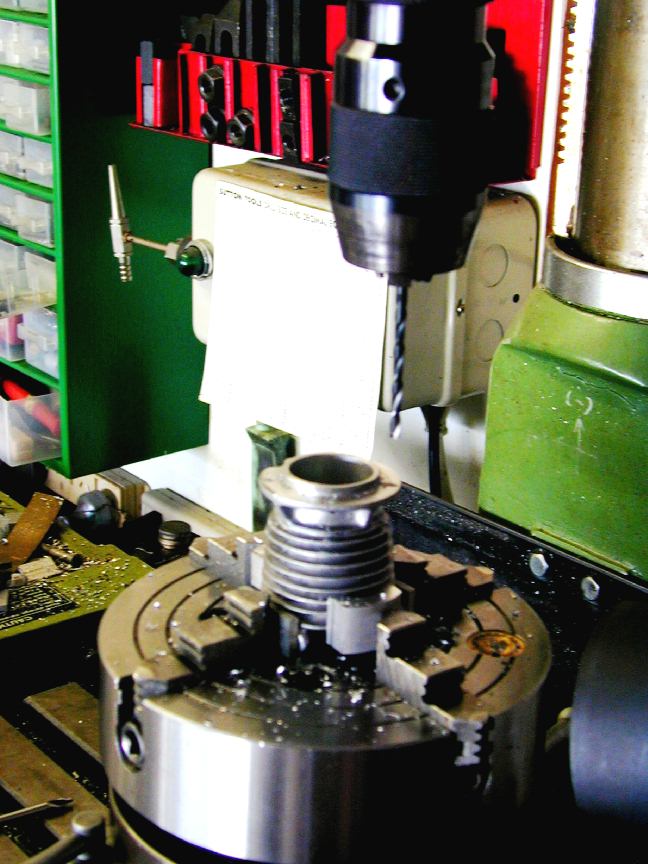 There's one more use for this set-up. With the chuck transferred to the mill, the cylinder bore can be centered and the cylinder bolt holes drilled. The pattern in not on 90 degree radials. The rear ones are further apart to clear aspects of the cam train and the ones at the front are closer than 90 degrees apart for no readily apparent reason. Never mind. They are drilled now to clear 6-32 machine screws and we'll "spot" from them into the case flange later. As usual, after centering, I use the mill's digital readout (DRO) to "co-ordinate" drill the holes. As I've said here before, the Newall DRO is the only thing that makes the Pile Of Junk I laughingly call a mill remotely bearable.

 The next operations require work on the top of the cylinder, so a dummy mounting flange is made up that can be held in a chuck, bolted to the mill table, or attached to an angle plate. With the cylinder mounted in this jig and the jig held in the 3 jaw self-centering chuck (3JSC) mounted on the rotary table, it's easy to mill the exhaust and carby flanges to final size so they are both the same distance from the cylinder axis. The 4-40 mounding holes are drilled and tapped at the same setting

 With the jig bolted to the mill table so the cylinder is vertical and aligned with the table axis, the valve guide holes can be drilled and reamed, together with the blind, tapped hole for the rocker mounting post. There is not a lot of metal for this post to thread into, depth-wise, and we certainly don't want to go too deep and break into the combustion chamber! Measure twice; cut once. After the valve guides are finished, the two small blind holes that locate the "hair-pin" valve spring ends can be spotted. While the cylinder is vertical, mount up a 3/16" end mill and contour the depression in the flying-butress off the back of the cylinder crown that will locate the fuel tank. Notice that the 4-40 blind hole for the mounting screw was drilled and tapped while the head was horizontal in the previous setup.

Drilling and tapping for the spark plug is a bit more difficult as it is inclined forward, 15 degrees off the vertical. After thinking, plotting and head scratching, I finally decided the best way was to rotate the mill head. I was trying to avoid this as I'd have to "swing" the head after to get it true to the table again. This is not difficult, or time consuming and probably should be done every so often anyway.
 This shot shows my set-up for swinging the head. I'm using bits from the magnet base to hold a plunger type dial indicator so it can be rotated from side to side. When the DTI reads the same at both extremes, the quill must be normal to the table (at least normal in the only plane we can do anything about!) Because of the DTI mounting, the dial will be facing the wall when swung to the left—hence the mirror on the table so I can see the dial (crude, crude...). Obviously the wider the arc the DTI is swung through, the more accurate the adjustment can be.
Now we come to the really, really hard part. The valve guides have been drilled and the corresponding head ports have to be opened out. These have to be as circular as possible, and be on the same axis as the guides if the valves are to seal. As mentioned earlier, the cast-in openings are really rough and nothing like circular. I wish they weren't there at all. They are also hard to get at way up in that blind bore. And workholding would be a nightmare (getting the valve guides lined up in all 3 planes). Life would have been simpler if the openings didn't exist, but they do, so we need a plan.
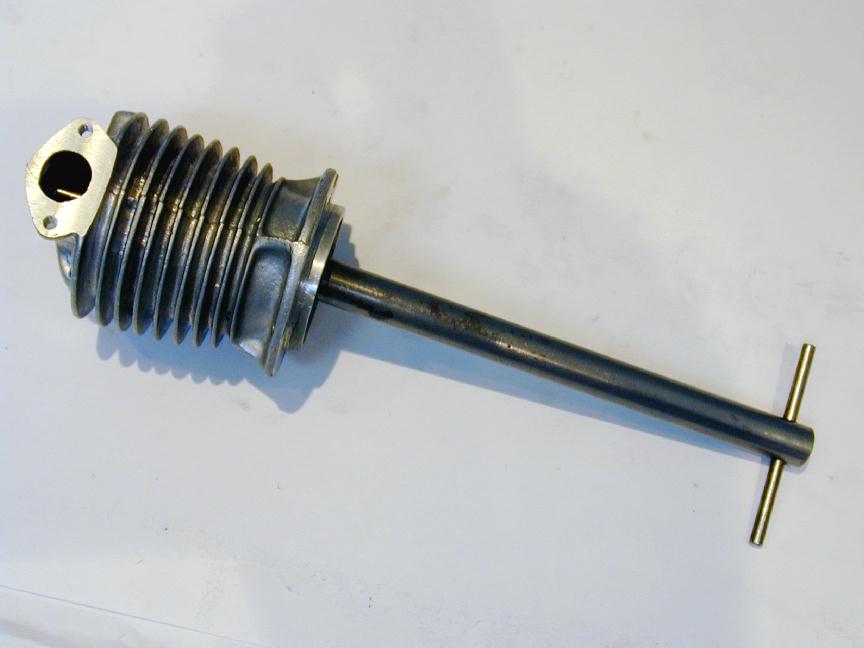
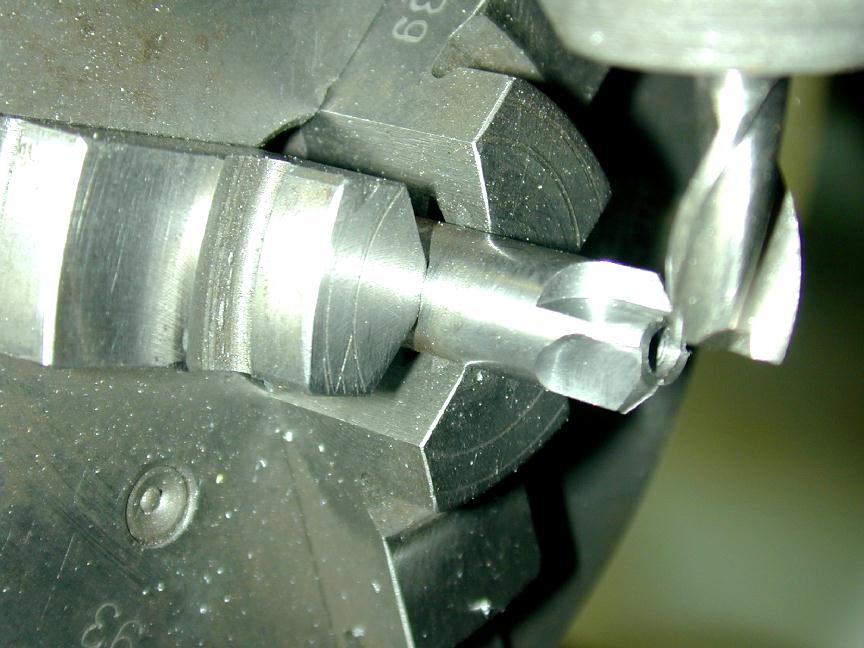 The plan is to use a shop-made piloted, tapered reamer, turned by hand, with the cylinder hand held, to gradually chew off the protrubences along the core join lines and *hopefully* end up with holes that are round enough and concentric enough with the valve guides to achieve a seal. This pic shows step two of making the cutter. The tool is made from 3/8" drill rod, drilled for the 0.125" drill rod pilot pin. The taper has been turned so that the paralled flanks will break through before the taper part bottoms on the roof of the port cavity. Here, 4 teeth are milled onto the tool flanks. The other end of the piloted reamer is drilled and tapped 1/4-20 for a socket head screw. This lets us use a T-bar Allen key tool to rotate the cutter. After hardening and tempering, the cutting faces are touched up on the Quorn to grind in a few degrees of relief. The tool will cut a valve opening of about 0.370". Incidentally, try as I might, I could not locate anywhere on the plan the diameter for the valve seat opening! The valve head diameter was no help as it is misquoted so oversize the valves would be un-insertable! I've settled on a valve head diameter of 0.400".

Before starting, the cast-in openings are circularized as well as possible with a burr in the Dremel hand tool (taking care not have a runaway that will tear up the roof of the cylinder—should have done this before boring the casting). Then the pilot is inserted into the valve guide and away we go. I can feel the extra pressure points as the teeth encounter the irregular hole edges. Each such encounter is trying to push the reamer off center, but gradually the taper evens things out and the last few thou seem to be cutting uniformly. Here we see the cutter penetrating into a port cavity. Note how little metal there is for the (unbushed) valve guide.


Before and After. These shots show one valve seat and opening gnawed away, and one more to go, then both opened out. In the first shot, we can clearly see the "dimension" of the problem. Any resemblence between the cast-in opening and a valve hole is coincidental. Line-up with the valve guide is coincidental too. The hole that has been cut does not look very circular, and has a prominent burr on the edge. I'm hoping that I can lap/home a decent seat onto that mess and achieve an effective seal under compression. In the second shot, both have had the treatment. The second one is better, but still not outstanding. There must have been a better way to do this, but I'm damned if I know what it is. Perhaps two piloted reamers; one undersize by 20 thou (0.350"), piloted by the 1/8" valve guide hole to get the hole close to circular, then the final one with 1/8" and .350" pilots to ream to final size? Oh well... let's press on regardless...

Here we see an interesting problem that Roger Schroeder and I would love to get to the bottom of. We have theories a-plenty, but no definitive explaination. This shot was taken as the first attempt at making the thin-wall liner was nearing completion. The stock (12L14) had been turned, with tailstock live center support, to a glue-in fit (ie, between 1 to 2 thou undersize). It had then been drilled out progressively to 1", and bored to the final 1-1/16" bore. As the walls got thinner, a pattern of bands started to develop on the ID. Varying the feed rate had no effect. Worse, I could "feel" them—first with the telescoping bore gauge, then with my finger!! The cylinder was a write-off.

Following a plea to the Motor Boys via email, the suggestion was to damp out the work with rubber bands, or electrical tape. I tried this on the reject part still in the chuck, boring only to half depth. It helped, but the bands were still there, and still the same distance apart, even though the bore now felt smooth. In this shot, the reject has been sectioned to show the effect. Measurement shows the bands are a uniform 1/8" apart and appear to have "lead". The leadscrew of the Myford is 8 TPI. Are we beginning to smell rat soufflé?

At Roger's urging, I measured the variation as best I could. The process required three hands, hence the micrometer in the bench vise. To measire on the ID, a ball bearing is used as an anvil to give point-contact (a smaller ball would have been better). The result was an average of four tenths (0.0004") from crest (bright sections) to troughs (darker bands). In the section bored with tape and rubber bands wound around the outside, the average was less than two tenths. The bad part may have been actually worse as I'd tried honing the bore a bit to see if it would clean up before finding it didn't want to and declaring the whole thing kaput.

So, attempt #2: The OD is turned and the ID drilled as before. Then a run of closely spiraled electrical PVC tape was wound around the outside, followed by an old, dead Wakefield motor (1/4" x 1/16" flat rubber strip). This was not would tightly; just enough stretch to hold it comfortably in place. It had also been suggested to me that not making the walls so thin might help. I decided to bore to about 1.050" which would increase the walls from 0.025" to 0.032". I end up with a 14.65cc Feeney instead of a 14.98cc Feeney. Big deal; I can live with that. Damn thing probably won't run anyway unless I can cure the valve opening problem.
Finally, the liner is glued into the casting with high-temperature Locktite kindly mailed to me by a most gracious and kind reader who had read my earlier tales of woe (drat, no excuse not to finish the Mortons M5s now...  )
)


This time, no sign of the "banding" problem. I almost certainly could have continued out to the 0.025" walls, but stuck to the plan. After boring, the cylinder was used to mark the part-off point and the liner parted off. The photo shows a rod (grease pencil in this case) chucked in the tailstock to catch the part as it is parted off—we certainly don't want thin wall tube bouncing around the suds tray. The liner is then honed with an automotive-type break cylinder hone. This will hopfully produce a parallel bore with the highly desirable "diamond" pattern of scratches in the walls that is supposed to aid oil retention with ringed engines.

Back to Feeney Journal front page